The Next Frontier: Investing in the Great Unknown
Space has always been a source of profound fascination. Like most, I've spent countless nights gazing up at the stars in wonder, grappling with the scale of the universe. Is it infinite? We don't even know. The universe is so vast that, governed by the laws of physics, there are regions we will literally never be able to see.
But today, space is more than just a philosophical curiosity. It is being viewed with prying, competitive eyes. We are already seeing the Moon discussed as a potential area of geopolitical conflict — a typical human development.
What fuels this push into the cosmos? Is it wonder, profit, or survival? Perhaps it's a cocktail of all three. Regardless of the motive, one thing is certain: there is massive opportunity on the horizon.
The Economy of the Stars
We are standing at the intersection of three massive technological leaps:
AI & Automation: The ability to operate in environments too hostile for humans.
Robotics: Advanced machinery capable of complex tasks like asteroid mining for industrial metals.
Reduced Launch Costs: Innovations from companies like SpaceX have made reaching orbit more economical than ever before.
This isn't science fiction — it's a matter of time and economics. When you combine resource extraction with exploration, colonialism, and tourism, you aren't just looking at a new sector. You're looking at the "New World" distilled into a single investment theme.
The Scale of the Opportunity
Morgan Stanley projects the global space economy will grow from approximately $630 billion today to over $1 trillion by 2040. That's not a rounding error — that's a near-doubling of an entire industry in under two decades, driven by compounding technological breakthroughs rather than incremental improvement.
For context, the internet economy took roughly the same timeframe to go from niche curiosity to the backbone of global commerce. The investors who positioned early — in Amazon, in Google, in the infrastructure layer — captured generational returns. Space is that same inflection point, earlier in the curve.
For those looking to capture this growth without picking individual winners, there are specialised vehicles like the VanEck Space Innovation ETF (JEDI). With a current fund size of approximately $6.3 billion in assets under management, it holds shares across the companies leading these ventures — launch providers, satellite operators, defence contractors, and the enabling technology stack beneath them. UK investors can access equivalent exposure through UCITS-compliant funds like ARKX on the London Stock Exchange.
The question isn't whether the space economy grows. It's whether you're positioned before the mainstream capital flows in.
The Alphameter Angle
Space is not a regime-agnostic theme. It is unambiguously a risk-on asset — high beta, high growth, sensitive to liquidity conditions and investor appetite. When the Alphameter signals risk-off, capital rotates away from speculative growth and into safety. Space stocks get hit hard.
But during risk-on episodes — confirmed by AUD/JPY, Copper/Gold, sector rotation, and the rest of the indicator basket — space innovators consistently outperform. My own five-year trading history reflects this exactly: space technology was my single most profitable theme, accounting for over a third of all realised gains. Every significant position was held during confirmed risk-on conditions.
The Alphameter doesn't tell you which space company to own. It tells you when the macro environment favours owning them. That's the edge.
The Bottom Line
Imagine the impact of a consistent, monthly investment into a sector with that kind of trajectory — sized to what you can afford, held through confirmed risk-on episodes, and rotated out when the regime turns. We are talking about the potential for generational wealth, built systematically rather than on hope.
Of course, there is always the existential risk — the possibility that we destroy ourselves before we truly get off the rock. But if that happens, we'll have much bigger problems than our portfolios. For those who believe in human ingenuity and perseverance, the stars aren't just for looking at — they're for building a future.
Peace and love.
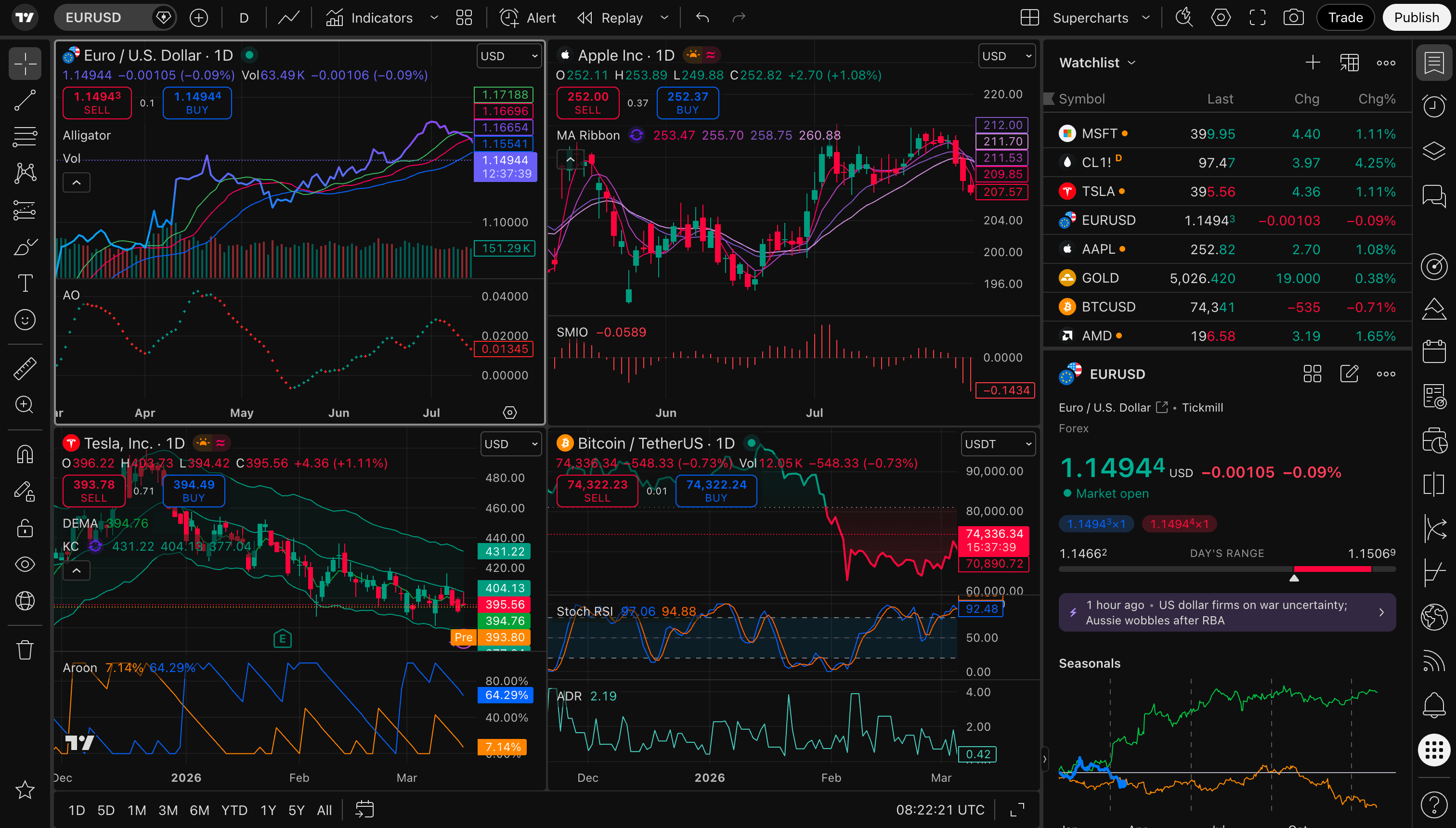

Free charts, alerts, and screeners for every asset discussed on this page. Used by 50M+ traders.
More from the blog
This content is for informational purposes only and does not constitute financial advice.