The School of Alphamancy
Master the macro indicators, strategies, and frameworks that drive market regimes. 70 topics across 8 categories — all free.
Indicators & Signals(13)
What Is the VIX? The Fear Index Explained
Learn what the VIX volatility index measures, why it's called the fear gauge, and how contrarian investors use elevated VIX readings as buy signals.
Risk-On vs Risk-Off: Understanding Market Regimes
Understand risk-on and risk-off market regimes, what drives regime shifts, and how to position your portfolio based on the current macro environment.
Copper/Gold Ratio: The Economy's Real-Time Health Check
Learn how the copper/gold ratio signals economic expansion or contraction, why copper represents growth and gold represents fear, and how to use it.
AUD/JPY Carry Trade: The FX Risk Sentiment Barometer
Discover why the AUD/JPY currency pair is a powerful risk sentiment gauge, how carry trade mechanics work, and how Alphamancy uses it as a contrarian signal.
DXY Dollar Index: What a Strong Dollar Means for Markets
Understand the DXY dollar index, its trade-weighted basket composition, why a strong dollar pressures risk assets, and how Alphamancy tracks it.
Sector Rotation: Reading the Economy Through Stock Market Leadership
Learn how sector rotation between cyclical and defensive stocks signals economic expansion or contraction, and how the Alphameter uses this macro indicator.
Bond Yield Analysis: What Rising and Falling Yields Signal
Understand how bond yields signal growth expectations, inflation fears, and recession risk. Learn the 10Y yield, 2s10s spread, and how Alphamancy tracks them.
Credit Spreads: The Bond Market's Risk Thermometer
Learn how corporate bond spreads between high-yield, investment-grade, and Treasuries signal financial stress or confidence, and why they matter for equities.
VIX Term Structure: Contango, Backwardation, and Timing Signals
Understand the VIX futures curve, why contango is normal and backwardation signals panic, and how the term structure provides actionable timing signals.
Put/Call Ratio: The Contrarian Sentiment Indicator
Learn how the put/call ratio measures market sentiment, why extreme readings are contrarian signals, and the difference between equity and index put/call ratios.
Commitment of Traders (CoT): How to Read Futures Positioning
Learn to read the CFTC Commitment of Traders report — trader categories, net position, the COT index, and why crowded speculator positioning is a contrarian signal.
The CoT Backtest: 20 Years of Historical Positioning Behavior
A rigorous 20-year audit of how seven markets behaved historically when CFTC Commitment of Traders positioning sat at similar conditions. Base-rate framed, per-market horizons, market character profiles — descriptive past, not future predictions.
CoT Power Setups: What Each Tier Means
Plain-English explanation of every CoT power-setup tier on the Alphamancy dashboard: All-Actor Confluence, Dual Confirmation, Confirmed Washout, Smart-Money Confirmation, Solo Capitulation, and Anti-Fade Warning.
Macro Concepts(10)
Yield Curve Explained: The Bond Market's Recession Radar
Learn how the yield curve predicts recessions, what normal, flat, and inverted curves signal, and how to use the 2s10s spread in your macro investing framework.
Quantitative Easing Explained: How the Fed Prints Risk Appetite
Understand how quantitative easing works, why the Fed buys bonds to lower yields, and how QE and QT directly impact stock prices, bonds, and risk appetite.
Inflation vs Deflation: The Macro Force That Drives Everything
Learn the difference between inflation and deflation, how CPI and PCE measure price changes, and which assets perform best in each macro environment.
The Federal Reserve Explained: How the Fed Moves Markets
Understand the Federal Reserve's dual mandate, how the FOMC sets rates, what the dot plot signals, and why the Fed is the most powerful force in global markets.
GDP and Markets: Why Growth Data Moves Stocks
Understand how GDP components drive markets, why stocks move before GDP prints, and how to use growth data as a leading indicator for macro investment decisions.
Money Supply M2: The Liquidity Engine Behind Asset Prices
Learn the difference between M1 and M2 money supply, how money velocity affects inflation, and why M2 growth is a powerful leading indicator for asset prices.
Business Cycle Investing: Positioning for Each Economic Phase
Master the four phases of the business cycle, learn which asset classes outperform during expansion, peak, contraction, and trough, and identify cycle turns early.
Fiscal Policy and Markets: How Government Spending Moves Prices
Learn how government spending, taxation, and deficit policy affect stock and bond markets, and understand the critical interaction between fiscal and monetary policy.
Interest Rates and Stocks: The Discount Rate That Rules Valuations
Understand how interest rate changes affect stock valuations through the DCF discount rate, drive growth-value rotation, and shape the returns of rate-sensitive sectors.
Purchasing Managers' Index: The Economy's Monthly Pulse Check
Learn how ISM Manufacturing and Services PMI work, what the 50-level threshold signals, and how to use PMI sub-components as leading indicators for markets.
Asset Classes(10)
Gold as a Safe Haven: The Ultimate Portfolio Insurance
Discover why gold remains the premier safe haven asset, how real interest rates drive its price, the role of central bank buying, and gold's track record during crises.
Treasury Bonds Explained: The Foundation of Global Finance
Master Treasury bonds — T-bills, notes, bonds, and TIPS. Learn duration risk, the inverse price-yield relationship, and why Treasuries anchor the global financial system.
Bitcoin as a Macro Asset: Digital Gold or Risk-On Bet?
Analyze Bitcoin's evolving role as a macro asset class — digital gold narrative, correlation shifts, halving cycles, institutional adoption, and performance across regimes.
Commodity Supercycles: Understanding 20-Year Bull and Bear Markets
Learn about commodity supercycles — 15-20 year bull and bear phases driven by supply constraints, demand shifts, and structural underinvestment in physical resources.
Small Caps vs Large Caps: The Size Factor in Portfolio Construction
Compare small cap and large cap investing — the size premium, Russell 2000 vs S&P 500, rate sensitivity of small caps, and when the size factor leads or lags.
Uranium Investing: The Nuclear Renaissance and Supply Deficit
Explore uranium investing — the nuclear energy renaissance, structural supply deficit, enrichment bottlenecks, physical trusts like SPUT, and long-term contract dynamics.
Real Estate & REITs: Income-Producing Property in Your Portfolio
Learn how REITs provide liquid real estate exposure, their rate sensitivity, sector diversity from data centers to healthcare, and the inflation hedge debate.
Emerging Markets: Risk, Reward, and the Dollar's Shadow
Navigate emerging market investing — dollar dependency, current account risks, political instability, demographic dividends, and the macro conditions when EM outperforms.
Oil & Geopolitics: The World's Most Political Commodity
Understand oil as a geopolitical commodity — OPEC+ dynamics, supply disruption premiums, the oil-recession link, and how the energy transition reshapes oil pricing.
Dividend Aristocrats: The Power of Consistent Dividend Growth
Master dividend growth investing with the Aristocrats — companies with 25+ years of consecutive dividend increases, their defensive properties, and total return power.
Trading Strategies(13)
Dollar-Cost Averaging: Systematic Investing for All Markets
Learn how dollar-cost averaging reduces timing risk, when DCA beats lump sum investing, and how to combine DCA with regime-aware macro frameworks.
Momentum Investing: Riding Trends in Markets
Learn how momentum investing works, the 12-1 month momentum factor, momentum crashes, and how to combine price momentum with macro regime analysis.
Anchored VWAP From Macro Events
How to anchor VWAP to macro events — Fed decisions, CPI prints, gaps, regime flips — why the anchor is the whole decision, and what our own test of it found.
Price Action: Structure, Closes, and the Break-and-Retest
Market structure, running vs sweeping closes, and the break-and-retest — explained properly, then tested on 30 years of daily data, including what did not hold up.
Building a System You Can Actually Trust
From concept to execution: how to turn an idea into mechanical rules, backtest it honestly, forward test it without tampering, and make trading boring on purpose.
Volume: Who Was Behind the Move
Price tells you what happened, volume tells you who was behind it. High-volume reference levels, what volume cannot tell you, and the daily-bar test results.
There Is No Holy Grail
Why no single indicator works everywhere, the difference between a tool and a signal, leading versus lagging, and how to judge any indicator honestly — including ours.
Mean Reversion Strategy: When Markets Snap Back
Understand mean reversion in markets — what mean-reverts vs what trends, z-scores, Bollinger bands, and how to trade reversion setups effectively.
The Barbell Strategy: Combining Safety with Speculation
Learn Nassim Taleb's barbell strategy — combining ultra-safe assets with high-convexity speculative bets to build anti-fragile portfolios.
Hedging with Options: Portfolio Insurance Strategies
Master options hedging strategies including protective puts, collars, put spreads, and VIX-based timing to protect your portfolio cost-effectively.
Tail Risk Hedging: Protecting Against Black Swans
Learn tail risk hedging strategies to protect your portfolio against black swan events, fat tails, and extreme market drawdowns effectively.
Regime-Based Allocation: Adapting to Macro Environments
Learn how regime-based allocation works, why it outperforms static strategies, and how Alphamancy's Alphameter enables regime-aware portfolio positioning.
Tactical vs Strategic Asset Allocation: Finding the Right Balance
Compare tactical and strategic asset allocation approaches, learn when each works best, and how to combine them for superior risk-adjusted returns.
Risk Management(7)
Position Sizing: The Most Important Trading Decision
Master position sizing methods including percentage-of-portfolio, volatility-adjusted, and conviction-weighted approaches to manage portfolio risk.
Your Journal Is Your Edge
Why your edge lives in your own data, the fields worth logging on every trade, and a worked example of testing a journal hypothesis properly — including why it failed.
Maximum Drawdown: The Risk Metric That Matters Most
Understand maximum drawdown as the most important risk metric — recovery math, historical drawdowns by asset class, and drawdown-adjusted returns.
Sharpe Ratio Explained: Measuring Risk-Adjusted Returns
Learn how the Sharpe ratio measures risk-adjusted returns, what constitutes a good Sharpe, the Sortino alternative, and key limitations to understand.
Correlation and Diversification: The Only Free Lunch in Finance
Learn how correlation drives diversification, why correlations spike in crises, and how to build truly diversified portfolios across market regimes.
Kelly Criterion: Optimal Bet Sizing for Maximum Growth
The Kelly Criterion formula is f* = (bp - q) / b. Learn what each variable means, how to use it for trading and betting, why half-Kelly beats full Kelly, and common mistakes.
Stop-Loss Strategies: Managing Downside Risk on Every Trade
Master stop-loss strategies including fixed percentage, trailing, volatility-based ATR stops, time stops, and how to avoid stop loss hunting traps.
Economic Data(6)
Nonfarm Payrolls: The Most Market-Moving Data Release
Understand the NFP jobs report, establishment vs household surveys, why revisions matter more than headlines, and how markets react to employment surprises.
CPI Inflation Data: Reading the Most Watched Price Index
Master CPI inflation data: basket composition, core vs headline, shelter lag effects, and how markets violently react to CPI beats and misses each month.
GDELT News Sentiment: Mapping Global Events to Market Signals
Learn how the GDELT Project maps global news events into quantifiable sentiment data that investors can use as a macro indicator.
FRED Economic Data: The Investor's Free Research Powerhouse
Master FRED, the Federal Reserve's free economic database. Learn the key series every investor should track and how to use FRED for macro research and analysis.
Baltic Dry Index: The Unmanipulable Global Trade Barometer
Understand the Baltic Dry Index as a leading indicator for global trade and economic activity, why it resists manipulation, and its key limitations for investors.
Consumer Sentiment: What Confidence Surveys Reveal About Markets
Learn how UMich Consumer Sentiment and Conference Board Confidence surveys work, their predictive power for spending, and why extremes serve as contrarian signals.
Behavioral Finance(6)
Fear & Greed Index: Behavioral Sentiment Decoded
Understand the CNN Fear & Greed Index components, why extreme fear signals buying opportunities, and how prospect theory drives market sentiment cycles.
Anchoring Bias: How Reference Points Sabotage Investment Decisions
Learn how anchoring bias to past prices, cost basis, and analyst targets causes missed opportunities and poor exits, plus systematic strategies to overcome it.
Recency Bias: Why Investors Fight the Last War
Discover how recency bias causes investors to chase performance, misjudge regimes, and overweight recent narratives, plus frameworks for more balanced analysis.
Loss Aversion: Why Losses Hurt Twice as Much and How It Destroys Returns
Understand Kahneman and Tversky's prospect theory, the disposition effect of selling winners and holding losers, and systematic approaches to overcome loss aversion.
Overtrading, Revenge Trading, and Bad Risk
Why losses trigger fight-or-flight, what revenge trading actually is, the only honest definition of bad risk, and the structural fixes that work better than willpower.
Herd Mentality: Information Cascades and the Madness of Crowds
Explore how information cascades, FOMO, and social proof drive speculative manias, and how contrarian investors use crowd positioning as a profitable signal.
Geopolitics & Markets(5)
War and Markets: How Armed Conflict Reshapes Portfolios
Learn the historical pattern of markets dropping on war fears and recovering on resolution, defense sector dynamics, commodity disruptions, and sanctions cascades.
Sanctions and Investing: Navigating Economic Warfare
Learn how economic sanctions disrupt markets, the Russia sanctions case study, secondary sanctions risk, and strategies for building sanctions-resilient portfolios.
Deglobalization: Investing in the Reshoring Revolution
Explore how reshoring, friend-shoring, and supply chain diversification are reshaping global markets, their inflationary impact, and how to position portfolios.
US-China Trade War: Decoupling, Tariffs, and Investment Impact
Analyze US-China decoupling across trade, tech, and finance. Understand tariffs, export controls, rare earth risks, Taiwan semiconductor exposure, and portfolio implications.
Energy Security: National Strategy Meets Investment Opportunity
Explore how energy independence drives national security policy, European crisis lessons, the LNG buildout, nuclear renaissance, and critical mineral investments.
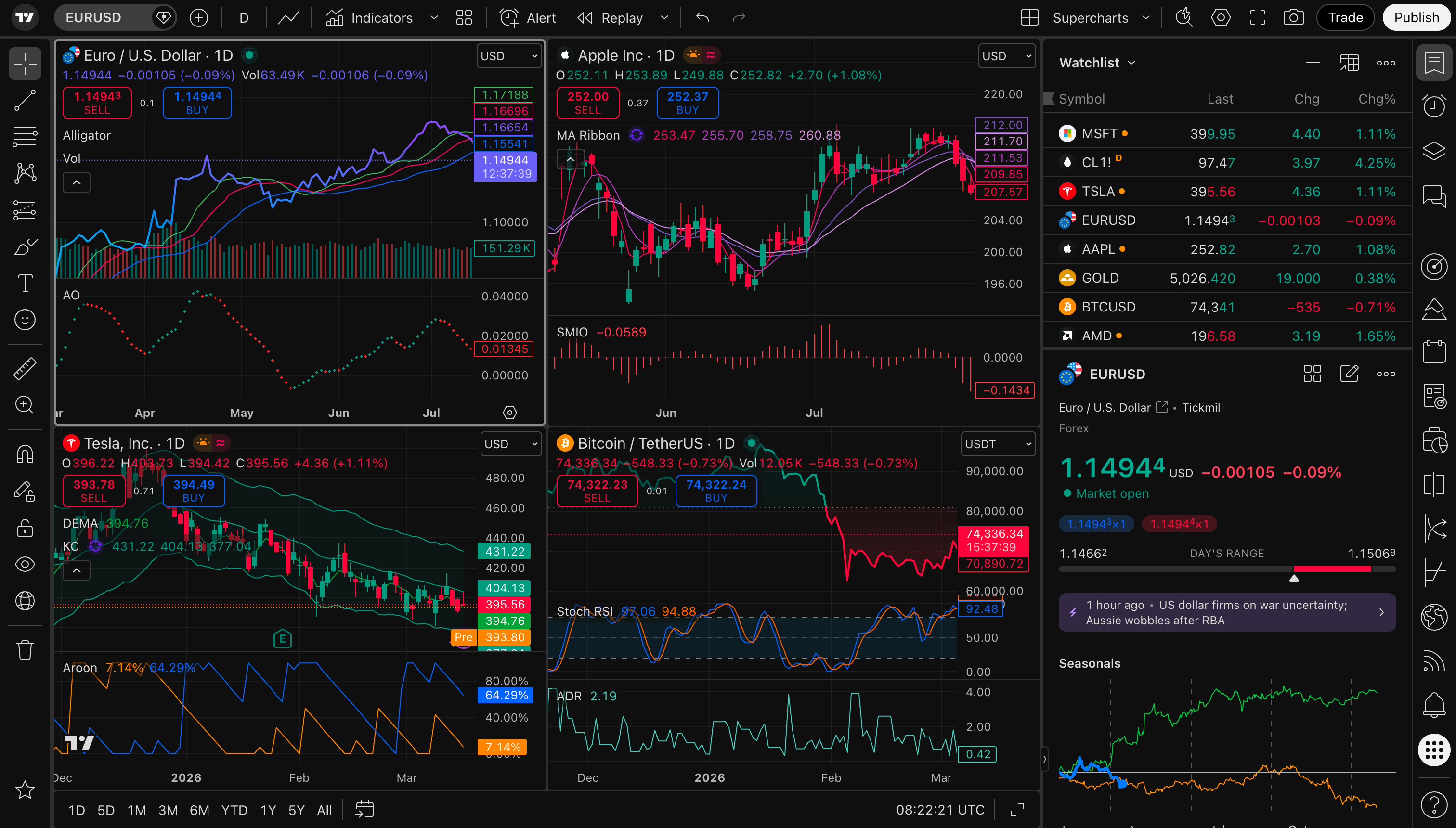

Follow every concept with live charts, alerts, and a free paper-trading account.
Stay Informed
Get notified when the market regime changes — max one email per day.
Regime alerts + weekly macro brief. Unsubscribe anytime.