DXY Dollar Index: What a Strong Dollar Means for Markets
Understand the DXY dollar index, its trade-weighted basket composition, why a strong dollar pressures risk assets, and how Alphamancy tracks it.
What the DXY Measures
The U.S. Dollar Index (DXY) measures the value of the US dollar against a basket of six major foreign currencies. The basket is heavily weighted toward the euro, which accounts for 57.6% of the index. The Japanese yen is next at 13.6%, followed by the British pound (11.9%), Canadian dollar (9.1%), Swedish krona (4.2%), and Swiss franc (3.6%). The index was established in 1973 with a base value of 100 after the Bretton Woods system of fixed exchange rates collapsed. A DXY reading above 100 means the dollar is stronger than its 1973 baseline against this basket, while a reading below 100 means it has weakened. Because the euro dominates the weighting, moves in EUR/USD have an outsized influence on the DXY, which is an important nuance to understand when interpreting the index.
| Currency | Weight |
|---|---|
| Euro (EUR) | 57.6% |
| Japanese yen (JPY) | 13.6% |
| British pound (GBP) | 11.9% |
| Canadian dollar (CAD) | 9.1% |
| Swedish krona (SEK) | 4.2% |
| Swiss franc (CHF) | 3.6% |
Why Dollar Strength Matters for Risk Assets
A rising dollar acts as a tightening force on global financial conditions, even without any action from the Federal Reserve. Most global commodities are priced in dollars, so a stronger dollar makes oil, copper, and agricultural products more expensive for non-US buyers, dampening demand. Emerging market economies that have borrowed in dollars face higher debt servicing costs when the dollar strengthens, which can trigger capital outflows, currency crises, and equity sell-offs in those markets. US multinational corporations earn a significant portion of their revenue overseas, and a strong dollar reduces the translated value of those foreign earnings when reported in dollars. For these reasons, sustained dollar strength above 105 on the DXY tends to coincide with stress in risk assets, particularly in emerging markets, commodities, and small-cap international stocks.
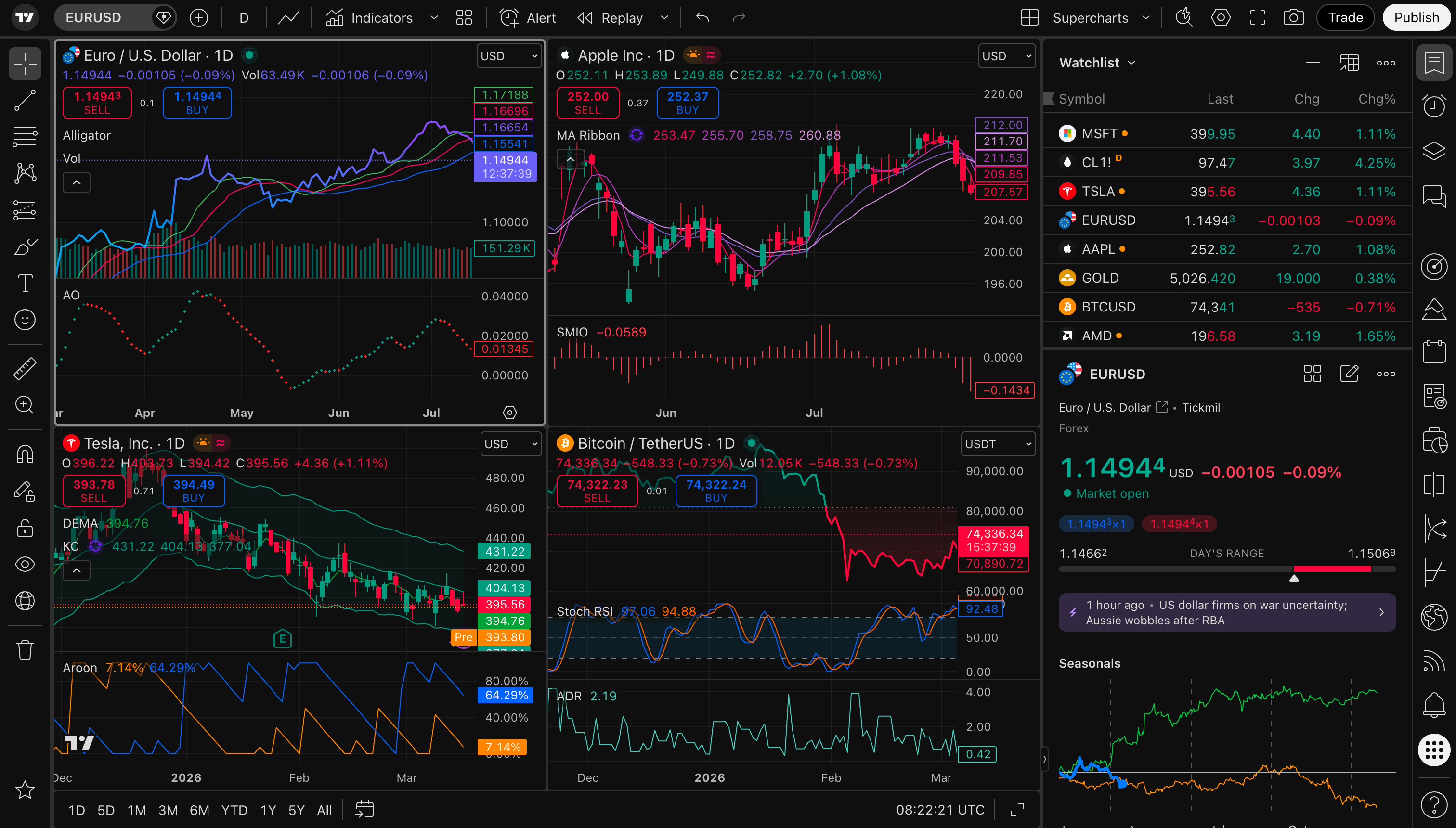

Free charts, alerts, and screeners for every asset discussed on this page. Used by 50M+ traders.
Dollar Regimes Through History
The dollar moves in long secular cycles that can last years. The early 1980s saw a massive dollar rally driven by Paul Volcker's aggressive rate hikes, with the DXY peaking above 160 in 1985 before the Plaza Accord engineered a coordinated devaluation. The 2000s saw sustained dollar weakness as the Fed held rates low and the global economy boomed. The 2014-2016 period brought a powerful dollar rally as the Fed began tapering and raising rates while Europe and Japan maintained ultra-loose policy. The 2022 dollar surge to 20-year highs above 114 was driven by the Fed's aggressive hiking cycle, which created massive interest rate differentials favoring the dollar. Each of these dollar cycles had profound implications for asset allocation, with dollar strength consistently correlating with underperformance in commodities, emerging markets, and gold.
How Alphamancy Uses the DXY
The Alphameter incorporates the DXY as a trend-following indicator with a 1x weight. Trend-following means the signal is read directionally: a strengthening dollar contributes a negative (risk-off) score because dollar strength historically corresponds with tighter global conditions and pressure on risk assets. A weakening dollar contributes a positive (risk-on) score because looser dollar conditions tend to support equity rallies, commodity booms, and emerging market strength. The 1x weight reflects that while the dollar is important, its signal can sometimes be ambiguous — the dollar can strengthen for positive reasons (strong US growth attracting capital) or negative reasons (global crisis driving safe-haven flows). Combining the DXY with other indicators like AUD/JPY and copper/gold helps disambiguate these scenarios.
Limitations and the DXY's Blind Spots
The DXY has a significant limitation: its basket composition is frozen in the 1970s and does not include the Chinese yuan, which is now the currency of the world's second-largest economy and largest trading nation. This means the DXY can miss important shifts in dollar strength relative to Asia. Some analysts prefer broader trade-weighted indices published by the Federal Reserve that include a wider set of currencies. Additionally, the DXY can be misleading during periods when the euro is moving for Europe-specific reasons (ECB policy changes, European political crises) rather than reflecting genuine shifts in dollar demand. For Alphamancy users, the DXY works best as one piece of a larger mosaic — it confirms the dollar regime but should be cross-referenced with the other five Alphameter indicators to form a complete macro picture.
Free charts, alerts, and screeners for every asset discussed on this page. Used by 50M+ traders.
Related Topics
Track These Indicators Live
The Alphameter synthesizes six macro indicators into a single regime score — updated daily. See the current reading and full indicator breakdown on the dashboard.
Get notified when the market regime changes
Regime alerts + weekly macro brief. Unsubscribe anytime.