Herd Mentality: Information Cascades and the Madness of Crowds
Explore how information cascades, FOMO, and social proof drive speculative manias, and how contrarian investors use crowd positioning as a profitable signal.
Information Cascades: When Rational Individuals Create Irrational Outcomes
An information cascade occurs when individuals sequentially observe the actions of others and rationally decide to follow the crowd rather than act on their own private information. In financial markets, this process can drive prices far from fundamental value. Imagine an investor who believes a stock is overvalued but observes that many respected funds are buying aggressively. The rational inference is that those funds may possess superior information, leading our investor to suppress their own analysis and buy as well. As each successive participant makes the same calculation, the cascade builds momentum and the collective action appears to confirm the wisdom of the trade, even though it may be built on a foundation of imitation rather than independent analysis. Information cascades are inherently fragile: they can reverse suddenly when a single credible contrarian voice breaks the chain of imitation, causing the cascade to collapse as quickly as it formed. This fragility explains why market sentiment can shift violently from euphoria to panic with no corresponding change in fundamentals.
FOMO and Social Proof in Financial Markets
Fear of missing out (FOMO) is the emotional engine that powers herding behavior in bull markets. When an investor watches peers, colleagues, and social media personalities profit from a trending asset, the psychological cost of being left out can overwhelm rational risk assessment. Social proof, the psychological principle that people look to others' behavior as evidence of what is correct, transforms from a useful heuristic in everyday life into a dangerous feedback loop in markets. Social media has dramatically amplified these dynamics: platforms like X, Reddit, and TikTok create real-time visibility into others' trades and profits, compressing the information cascade process from weeks to hours. The rise of retail trading during 2020-2021 demonstrated how social proof at scale can drive parabolic price moves in assets with no fundamental basis for valuation, as the act of buying became a social identity signal rather than an investment decision. The dopamine feedback loop of watching a crowded trade move in your favor reinforces participation, pulling in progressively less informed and more emotionally driven participants at exactly the point where risk is highest.
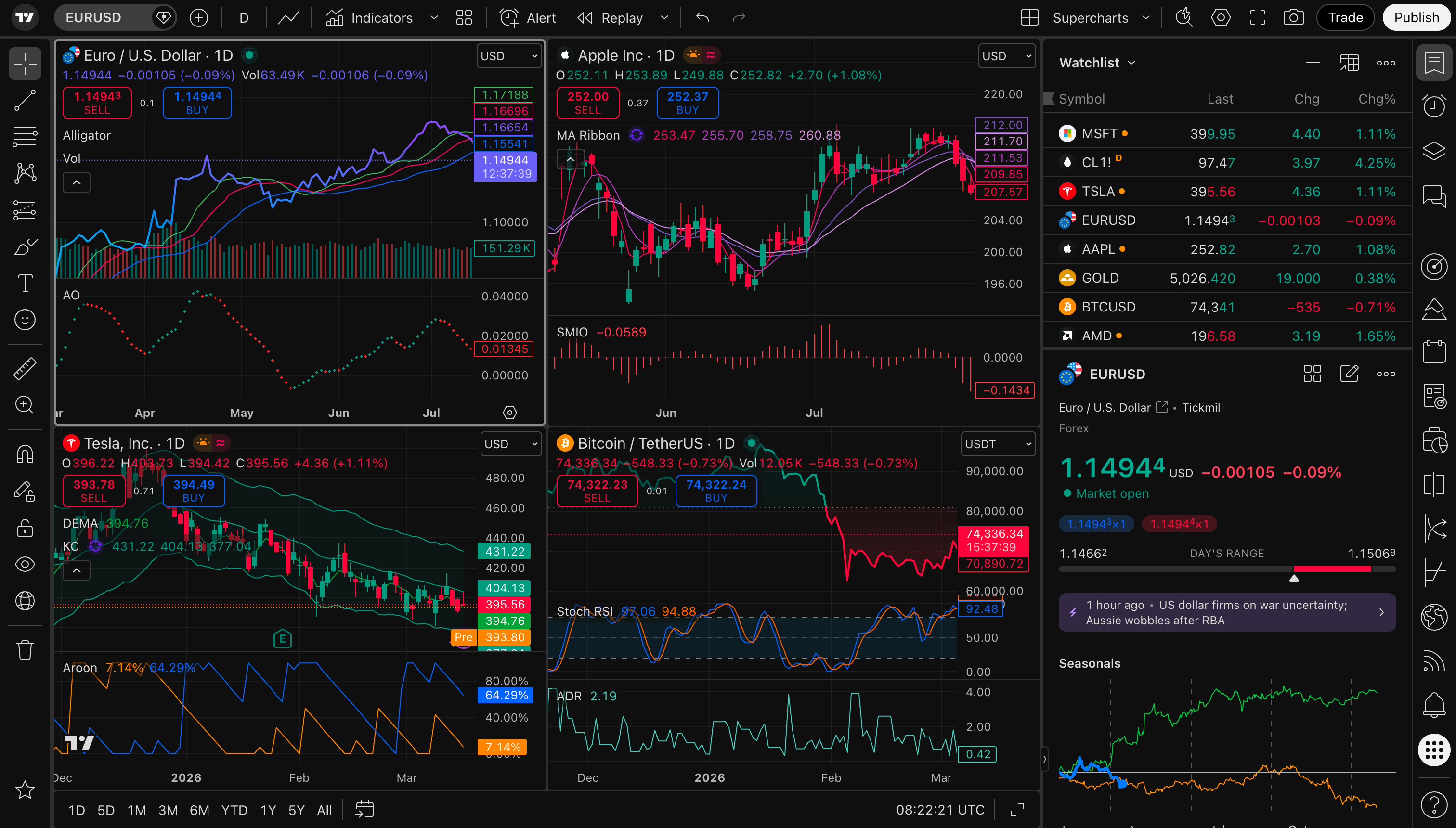

Free charts, alerts, and screeners for every asset discussed on this page. Used by 50M+ traders.
Meme Stocks and Speculative Manias
The GameStop episode in January 2021 provided a vivid modern case study of herd mentality amplified by technology. A combination of genuine short squeeze mechanics, social media coordination on WallStreetBets, zero-commission trading platforms, and narrative-driven momentum drove a stock from $20 to $483 in two weeks. The fundamental thesis was almost irrelevant; what mattered was the collective belief that buying would continue, which made buying rational as long as you exited before the music stopped. Historical speculative manias, from Dutch tulip bulbs to the South Sea Bubble to the dotcom mania, share remarkably similar structural patterns: an initially plausible thesis attracts early participants, whose profits attract imitators, whose buying drives further gains, creating a reflexive loop that detaches price from any anchoring valuation. Each mania feels different because the underlying asset changes, but the behavioral mechanics of herding, FOMO, and narrative reinforcement are identical. The painful lesson of every mania is that the last wave of participants, drawn in by the most extreme social proof, absorbs the losses that the early participants lock in as profits.
Contrarian Value of Crowd Positioning
While herding creates risk for those swept up in the crowd, it creates systematic opportunity for contrarian investors who can identify and fade extreme positioning. When the herd is maximally bullish, positioning is crowded, hedges have been abandoned, and the marginal buyer has already bought, leaving no one left to push prices higher. When the herd is maximally bearish, everyone who wants to sell has sold, creating a mechanical floor beneath prices as any positive catalyst triggers a short-covering rally. Quantitative measures of crowd positioning, such as the AAII Sentiment Survey, Investors Intelligence bull/bear ratio, CFTC Commitments of Traders data, put/call ratios, and fund flow data, provide objective readings of where the herd stands. Historically, buying when the AAII percent bearish exceeds 50% and selling or reducing exposure when percent bullish exceeds 50% has produced statistically significant excess returns. The key is patience and systematic execution: the crowd can remain irrational longer than contrarians expect, so position sizing and time horizon must accommodate the possibility of being early.
Sentiment Surveys as Contrarian Tools
Professional macro investors treat sentiment surveys not as predictive forecasts but as positioning indicators that reveal when the crowd has moved to one side of the boat. The AAII Individual Investor Sentiment Survey, published weekly, asks members whether they are bullish, bearish, or neutral on the market over the next six months. Readings above 50% bullish or above 50% bearish have historically been reliable contrarian signals, with extreme readings producing forward returns that are significantly different from the long-term average in the direction opposite to the sentiment extreme. The Investors Intelligence survey of newsletter writers provides a professional counterpart that captures the advisory community's consensus. When both retail and professional sentiment surveys reach extremes in the same direction, the contrarian signal is particularly powerful because it indicates broad-based herding across investor types. Combining sentiment surveys with objective market indicators like the VIX, credit spreads, and breadth data, as Alphamancy's Alphameter does, creates a robust framework that identifies genuine sentiment extremes while filtering out noise in the survey data. The goal is not to be reflexively contrarian but to recognize when herding has created a meaningful mispricing.
Free charts, alerts, and screeners for every asset discussed on this page. Used by 50M+ traders.
Related Topics
Track These Indicators Live
The Alphameter synthesizes six macro indicators into a single regime score — updated daily. See the current reading and full indicator breakdown on the dashboard.
Get notified when the market regime changes
Regime alerts + weekly macro brief. Unsubscribe anytime.