Risk-On vs Risk-Off: Understanding Market Regimes
Understand risk-on and risk-off market regimes, what drives regime shifts, and how to position your portfolio based on the current macro environment.
What Are Market Regimes?
A market regime describes the dominant mood driving asset prices. In risk-on environments, investors chase returns — equities rally, credit spreads tighten, commodities rise, and safe havens like Treasuries and gold underperform. In risk-off environments, fear dominates — investors flee to safety, equities fall, credit spreads widen, and defensive assets outperform. Regime identification isn't about predicting the future — it's about reading the current state of the market and aligning your positioning accordingly.
What Drives Regime Shifts
Regime transitions are driven by macro catalysts: central bank policy changes, geopolitical shocks, economic data surprises, or credit events. The shift from risk-on to risk-off can happen gradually (a slow deterioration in economic data) or violently (a sudden crisis). The reverse transition — from fear to greed — often starts when the worst fears fail to materialize and bargain hunters step in. Most market losses occur in the first few days of a regime shift, which is why monitoring leading indicators matters.
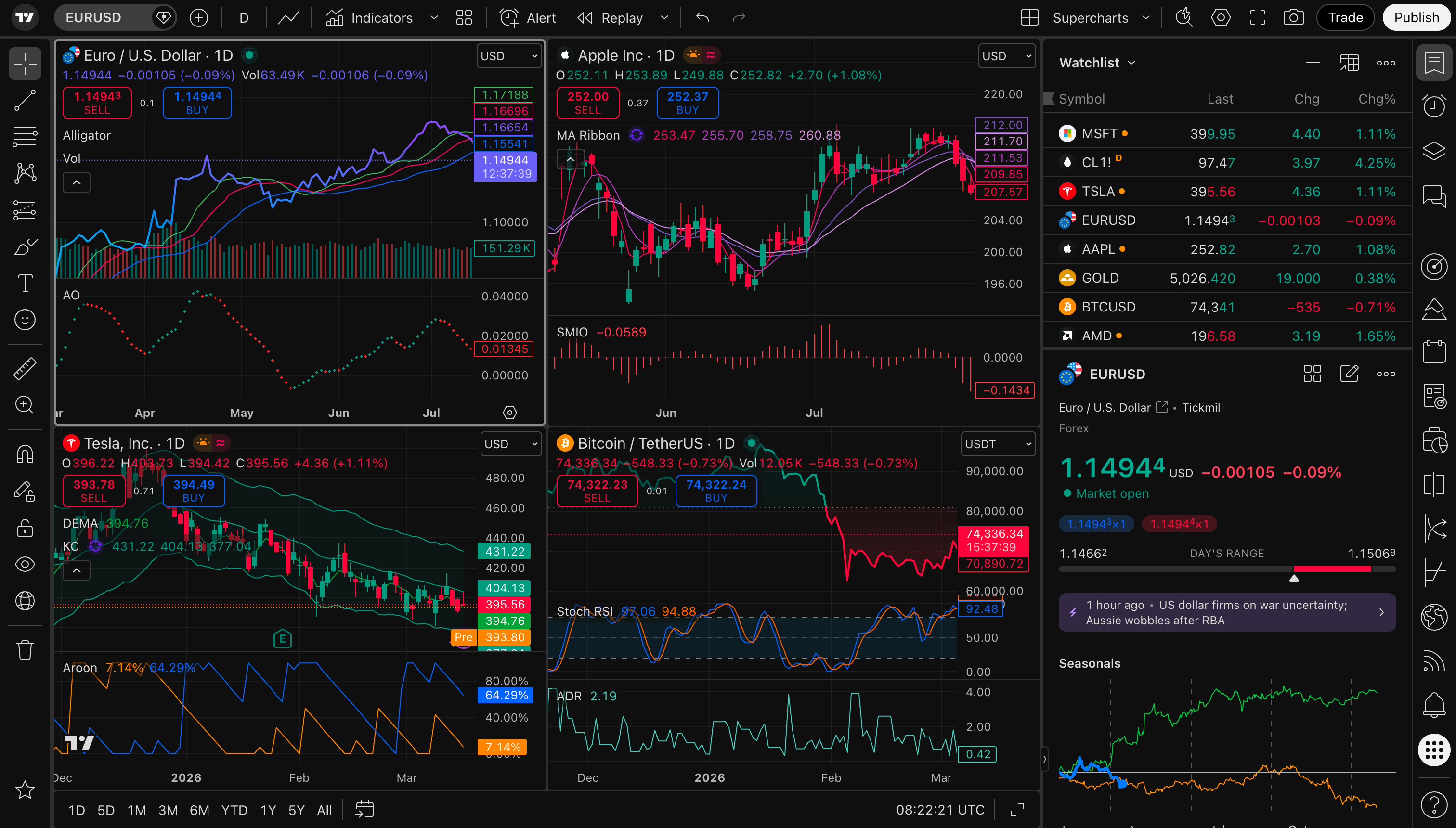

Free charts, alerts, and screeners for every asset discussed on this page. Used by 50M+ traders.
How Alphamancy Identifies Regimes
The Alphameter synthesizes six macro indicators — VIX, AUD/JPY, Copper/Gold ratio, Bond Yields, Sector Rotation, and DXY — into a single composite score. Scores above +25 indicate risk-on. Scores below -25 indicate risk-off. Scores between -25 and +25 are classified as neutral. Each indicator is weighted according to its predictive power, with some used in contrarian mode (VIX, AUD/JPY) and others in trend-following mode.
Positioning for Each Regime
Risk-on: Overweight equities, growth stocks, emerging markets, crypto, cyclical commodities. Underweight bonds, gold, cash. Risk-off: Overweight Treasuries, gold, defensive sectors (utilities, healthcare, staples). Reduce equity exposure. Neutral: Dollar-cost average into all positions. Maintain balanced allocation. Avoid leveraged bets. The key insight is that you don't need to predict regime changes — you just need to identify the current regime and ensure your portfolio isn't fighting the macro trend.
Historical Regime Patterns
Markets spend roughly 60-70% of the time in risk-on or neutral modes, with sharp but relatively brief risk-off episodes. The 2008 crisis was a sustained risk-off regime lasting roughly 18 months. COVID was an extremely compressed cycle — risk-off lasted only about 5 weeks before the Federal Reserve's intervention triggered a regime shift back to risk-on. Backtested data shows that a simple regime-aware allocation strategy significantly improves risk-adjusted returns compared to buy-and-hold.
Free charts, alerts, and screeners for every asset discussed on this page. Used by 50M+ traders.
Frequently Asked Questions
What does risk-on risk-off mean in investing?▼
Risk-on and risk-off describe the dominant mood driving financial markets. In risk-on environments, investors chase returns and equities rally while safe havens underperform. In risk-off environments, fear dominates and investors flee to safety assets like Treasuries and gold while equities decline.
What causes a shift from risk-on to risk-off?▼
Regime transitions are driven by macro catalysts such as central bank policy changes, geopolitical shocks, economic data surprises, or credit events. The shift can happen gradually through deteriorating economic data or violently through a sudden crisis. Most market losses occur in the first few days of a regime shift.
How should I invest during risk-off periods?▼
During risk-off periods, the typical strategy is to overweight Treasuries, gold, and defensive sectors like utilities, healthcare, and consumer staples while reducing equity exposure. The key is to identify the current regime and ensure your portfolio is not fighting the prevailing macro trend.
How much time do markets spend in risk-on vs risk-off?▼
Markets spend roughly 60 to 70 percent of the time in risk-on or neutral modes, with sharp but relatively brief risk-off episodes. The 2008 crisis was a sustained risk-off regime lasting about 18 months, while the COVID risk-off period lasted only about 5 weeks before the Fed's intervention triggered a shift back to risk-on.
Related Topics
Track These Indicators Live
The Alphameter synthesizes six macro indicators into a single regime score — updated daily. See the current reading and full indicator breakdown on the dashboard.
Get notified when the market regime changes
Regime alerts + weekly macro brief. Unsubscribe anytime.