Maximum Drawdown: The Risk Metric That Matters Most
Understand maximum drawdown as the most important risk metric — recovery math, historical drawdowns by asset class, and drawdown-adjusted returns.
What Is Maximum Drawdown
Maximum drawdown measures the largest peak-to-trough decline in portfolio value before a new peak is established. It captures the worst-case loss an investor would have experienced if they entered at the worst possible time and exited at the lowest point. Unlike volatility, which treats upside and downside moves symmetrically, drawdown isolates the downside experience — the actual pain an investor endures. A portfolio with 15% annual volatility might sound moderate, but if that volatility translates to a 45% maximum drawdown during a crisis, the lived experience is catastrophic. Maximum drawdown is the risk metric most closely tied to investor behavior because it represents the peak emotional and financial stress your portfolio can inflict.
The Recovery Math Problem
Drawdowns are asymmetric: the gain required to recover from a loss is always larger than the loss itself, and this asymmetry grows exponentially. A 10% loss requires an 11.1% gain to break even. A 20% loss requires 25%. A 33% loss requires 50%. A 50% loss requires 100% — you must double your remaining capital just to get back to where you started. A 75% loss, like many individual stocks experienced in 2008, requires a 300% gain to recover. This mathematical reality means that avoiding deep drawdowns is not just about comfort — it is the single most important factor for long-term compound growth. An investor who avoids a 50% drawdown and instead suffers only 20% will reach the same terminal wealth with a meaningfully lower average annual return because the compounding base is so much better preserved.
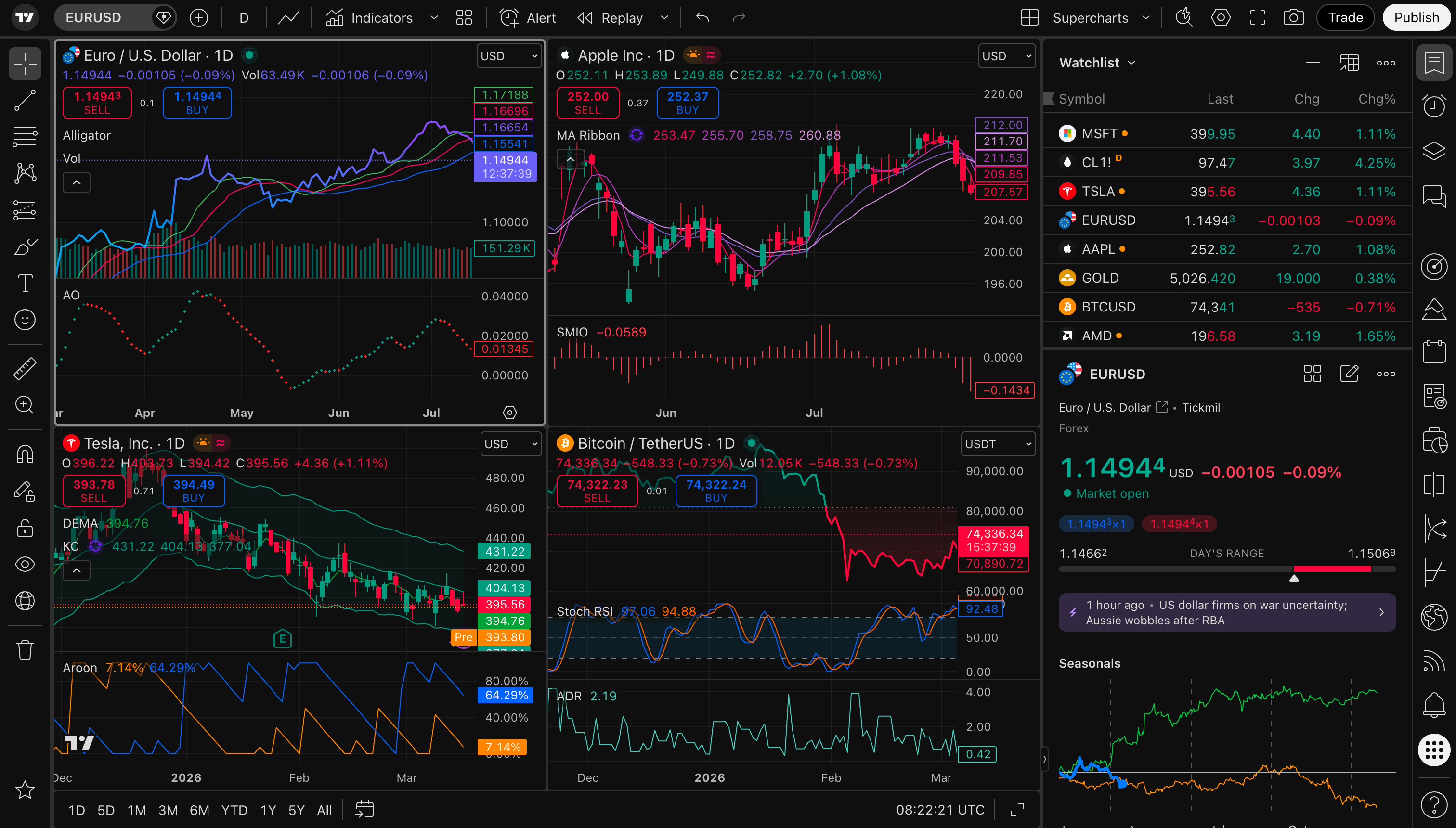

Free charts, alerts, and screeners for every asset discussed on this page. Used by 50M+ traders.
Historical Drawdowns by Asset Class
The S&P 500 has experienced drawdowns exceeding 45% three times since 1970: the 1973-74 bear market, the 2000-2002 dot-com bust, and the 2007-2009 financial crisis. Emerging market equities have seen drawdowns exceeding 60%. Long-term Treasury bonds, often considered safe, suffered a drawdown exceeding 40% during the 2020-2023 rate hiking cycle. Even the traditional 60/40 portfolio experienced a roughly 30% drawdown in 2008 and a meaningful drawdown in 2022 when stocks and bonds fell simultaneously. Commodities routinely experience 50% or greater drawdowns. Individual stocks can and do go to zero. Understanding the historical range of drawdowns for each asset class is essential for setting realistic expectations and sizing positions appropriately.
Drawdown-Adjusted Returns
The Calmar ratio divides annualized return by maximum drawdown, providing a measure of return per unit of worst-case pain. A strategy returning 10% annually with a 20% maximum drawdown has a Calmar ratio of 0.5, while a strategy returning 8% with a 10% maximum drawdown has a Calmar ratio of 0.8 — the latter is superior on a drawdown-adjusted basis despite lower absolute returns. The Sterling ratio uses average annual drawdown instead of maximum, providing a more stable measure. When comparing strategies or asset classes, always evaluate drawdown-adjusted metrics alongside absolute returns. A higher-return strategy is not better if it achieves those returns by taking on dramatically more drawdown risk that could trigger capitulation at the worst time.
The Psychological Impact of Drawdowns
Academic research on loss aversion shows that the psychological pain of losing money is roughly twice as intense as the pleasure of gaining the same amount. During a 40% drawdown, investors are not making rational calculations — they are in survival mode, prone to panic selling at the worst possible moment. The majority of permanent capital destruction in retail portfolios comes not from the drawdown itself but from the behavioral response to it: selling at the bottom and failing to re-enter before the recovery. This is why managing maximum drawdown is as much a behavioral strategy as a financial one. A portfolio with lower expected returns but smaller drawdowns will almost certainly outperform a higher-return portfolio with deeper drawdowns for the simple reason that the investor is far more likely to stick with it through adversity.
Free charts, alerts, and screeners for every asset discussed on this page. Used by 50M+ traders.
Related Topics
Track These Indicators Live
The Alphameter synthesizes six macro indicators into a single regime score — updated daily. See the current reading and full indicator breakdown on the dashboard.
Get notified when the market regime changes
Regime alerts + weekly macro brief. Unsubscribe anytime.