Position Sizing: The Most Important Trading Decision
Master position sizing methods including percentage-of-portfolio, volatility-adjusted, and conviction-weighted approaches to manage portfolio risk.
Why Position Sizing Matters More Than Entry
Professional traders consistently identify position sizing — not entry timing — as the primary determinant of long-term portfolio outcomes. A mediocre strategy with excellent position sizing will outperform a brilliant strategy with poor sizing over any meaningful time horizon. The reason is mathematical: position sizing controls the distribution of returns and the probability of ruin. A portfolio that risks 20% on a single trade can be wiped out by a string of five losses, regardless of how good the underlying signals are. Conversely, a portfolio that risks 1% per trade can survive dozens of consecutive losses and still recover. Position sizing transforms a random walk of wins and losses into a controlled, survivable process.
Percentage-of-Portfolio Methods
The simplest position sizing method is fixed fractional: risk a constant percentage of your current portfolio value on each trade. A common rule is the 1% rule — never risk more than 1% of total equity on any single position. If your portfolio is $100,000, you risk $1,000 per trade maximum. The position size is then calculated backward from your stop-loss distance: if your stop loss is 5% below entry, you can take a $20,000 position to stay within the $1,000 risk limit. Fixed fractional sizing has a self-correcting property — as your portfolio grows, position sizes grow proportionally, and as your portfolio shrinks, positions automatically decrease, reducing the probability of catastrophic loss.
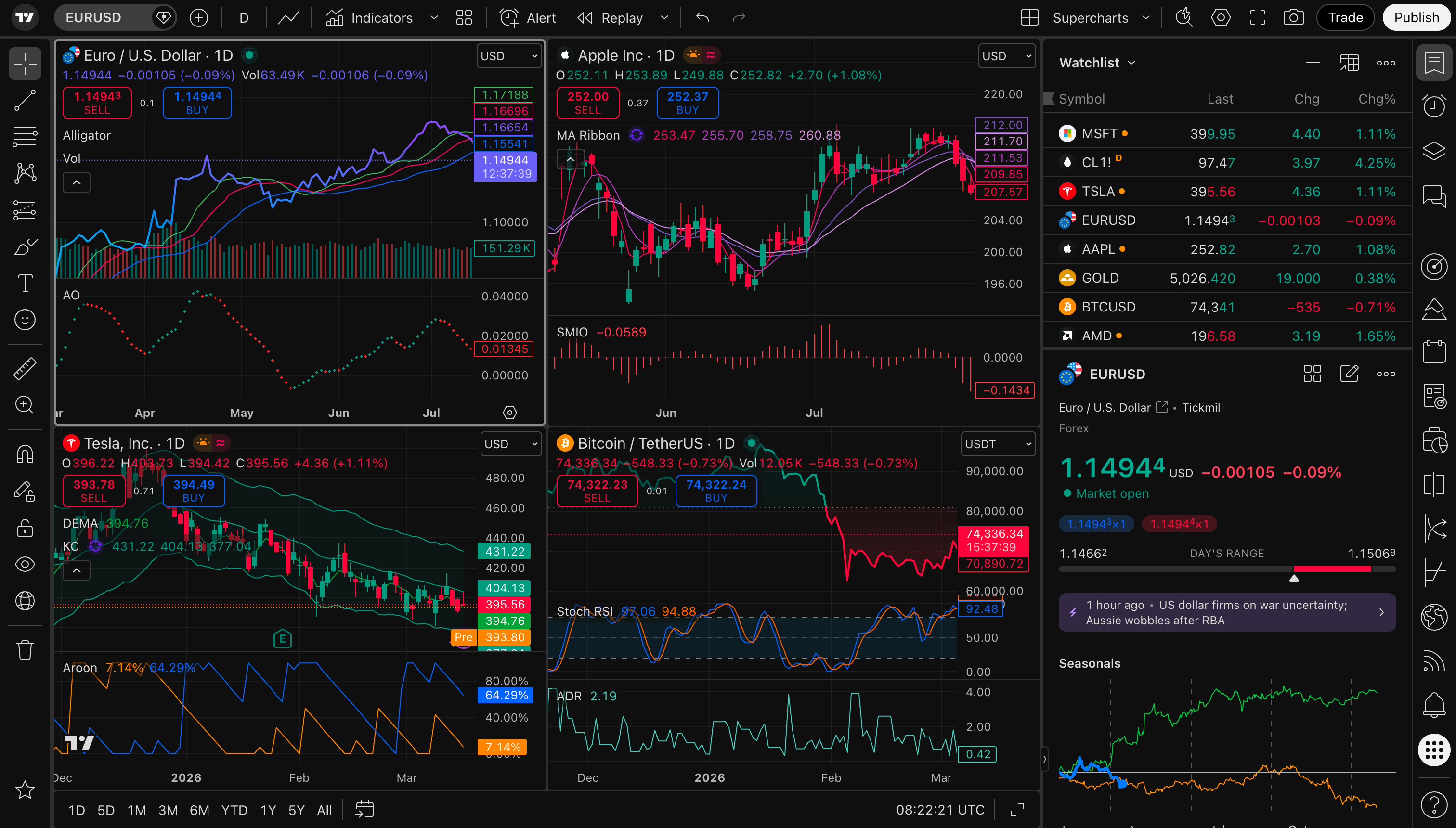

Free charts, alerts, and screeners for every asset discussed on this page. Used by 50M+ traders.
Volatility-Adjusted Sizing
Not all assets move the same amount. A 2% position in a low-volatility bond ETF carries far less risk than a 2% position in a high-volatility biotech stock. Volatility-adjusted sizing normalizes positions so that each contributes approximately equal risk to the portfolio. The standard approach uses Average True Range or historical standard deviation: divide your target dollar risk by the asset's daily ATR to determine the number of shares. This means you hold larger positions in calm, low-volatility assets and smaller positions in volatile ones. The result is a portfolio where no single position dominates the daily profit-and-loss, creating more consistent and predictable portfolio-level volatility.
Risk-Per-Trade Limits
Beyond individual position sizing, establish portfolio-level risk limits. Total portfolio heat — the aggregate amount at risk across all open positions — should not exceed 6 to 10 percent at any given time. This means if you risk 1% per trade, you should hold no more than 6 to 10 simultaneous positions at full risk. Correlated positions should be treated as a single risk unit: three oil stocks are not three independent bets but one concentrated energy bet. During elevated-risk regimes when correlations spike, reduce the number of open positions or cut individual position sizes to maintain the same aggregate risk budget. The portfolio risk limit acts as a circuit breaker that prevents overexposure regardless of how many attractive individual opportunities you identify.
Conviction-Weighted Sizing
Not all opportunities are created equal. Conviction-weighted sizing assigns larger positions to higher-conviction ideas and smaller positions to speculative ones, within the bounds of your overall risk framework. A practical implementation uses three tiers: full-size for high-conviction trades with multiple confirming signals, half-size for moderate-conviction trades, and quarter-size for exploratory positions. The critical discipline is that conviction must be based on the quality of the setup and the evidence, not on emotional attachment or outcome expectations. Even your highest-conviction position should still respect the maximum risk-per-trade limit. Conviction-weighted sizing allows you to express varying levels of confidence while maintaining the risk controls that ensure portfolio survival.
Free charts, alerts, and screeners for every asset discussed on this page. Used by 50M+ traders.
Frequently Asked Questions
What is position sizing in trading?▼
Position sizing is the process of determining how much capital to allocate to each individual trade based on your risk tolerance and the trade's characteristics. Professional traders consistently identify position sizing, not entry timing, as the primary determinant of long-term portfolio outcomes because it controls the distribution of returns and the probability of ruin.
What is the 1 percent rule for position sizing?▼
The 1 percent rule means never risking more than 1 percent of your total portfolio equity on any single position. If your portfolio is $100,000, you risk $1,000 per trade maximum. The position size is calculated backward from your stop-loss distance. This fixed fractional method automatically adjusts position sizes as your portfolio grows or shrinks.
How do you calculate position size based on volatility?▼
Volatility-adjusted sizing uses Average True Range or historical standard deviation to normalize positions so each contributes approximately equal risk. Divide your target dollar risk by the asset's daily ATR to determine the number of shares. This means larger positions in calm assets and smaller positions in volatile ones, creating more consistent portfolio-level behavior.
What is total portfolio heat?▼
Total portfolio heat is the aggregate amount at risk across all open positions and should not exceed 6 to 10 percent at any given time. If you risk 1 percent per trade, hold no more than 6 to 10 simultaneous positions at full risk. Correlated positions like multiple oil stocks should be treated as a single risk unit rather than independent bets.
Related Topics
Track These Indicators Live
The Alphameter synthesizes six macro indicators into a single regime score — updated daily. See the current reading and full indicator breakdown on the dashboard.
Get notified when the market regime changes
Regime alerts + weekly macro brief. Unsubscribe anytime.