Regime-Based Allocation: Adapting to Macro Environments
Learn how regime-based allocation works, why it outperforms static strategies, and how Alphamancy's Alphameter enables regime-aware portfolio positioning.
Why Regimes Matter for Allocation
Asset class returns are not independent of the macro environment — they cluster into distinct regimes where certain assets consistently outperform and others consistently underperform. During risk-on regimes driven by economic expansion and easy monetary policy, equities, credit, and cyclical commodities outperform. During risk-off regimes driven by recession fears or financial stress, Treasuries, gold, and defensive equities outperform. A static allocation ignores these regime dynamics and maintains the same positioning regardless of the macro backdrop. Regime-based allocation identifies the current macro state and tilts the portfolio toward assets that historically perform best in that environment.
Evidence for Regime Switching
Academic research on Markov regime-switching models demonstrates that asset returns follow different statistical processes in different states — the mean, volatility, and correlation structure all shift between regimes. Backtests across multiple decades and geographies consistently show that a simple two-state regime model improves risk-adjusted returns by 1 to 3 percentage points annually compared to static buy-and-hold strategies. The improvement comes primarily from risk reduction rather than return enhancement: regime-aware portfolios avoid the worst drawdowns by reducing equity exposure during risk-off periods. Even imperfect regime identification — getting it right 60 to 65 percent of the time — is sufficient to generate meaningful outperformance because the penalty for being wrong during regime transitions is much smaller than the benefit of being right during sustained regimes.
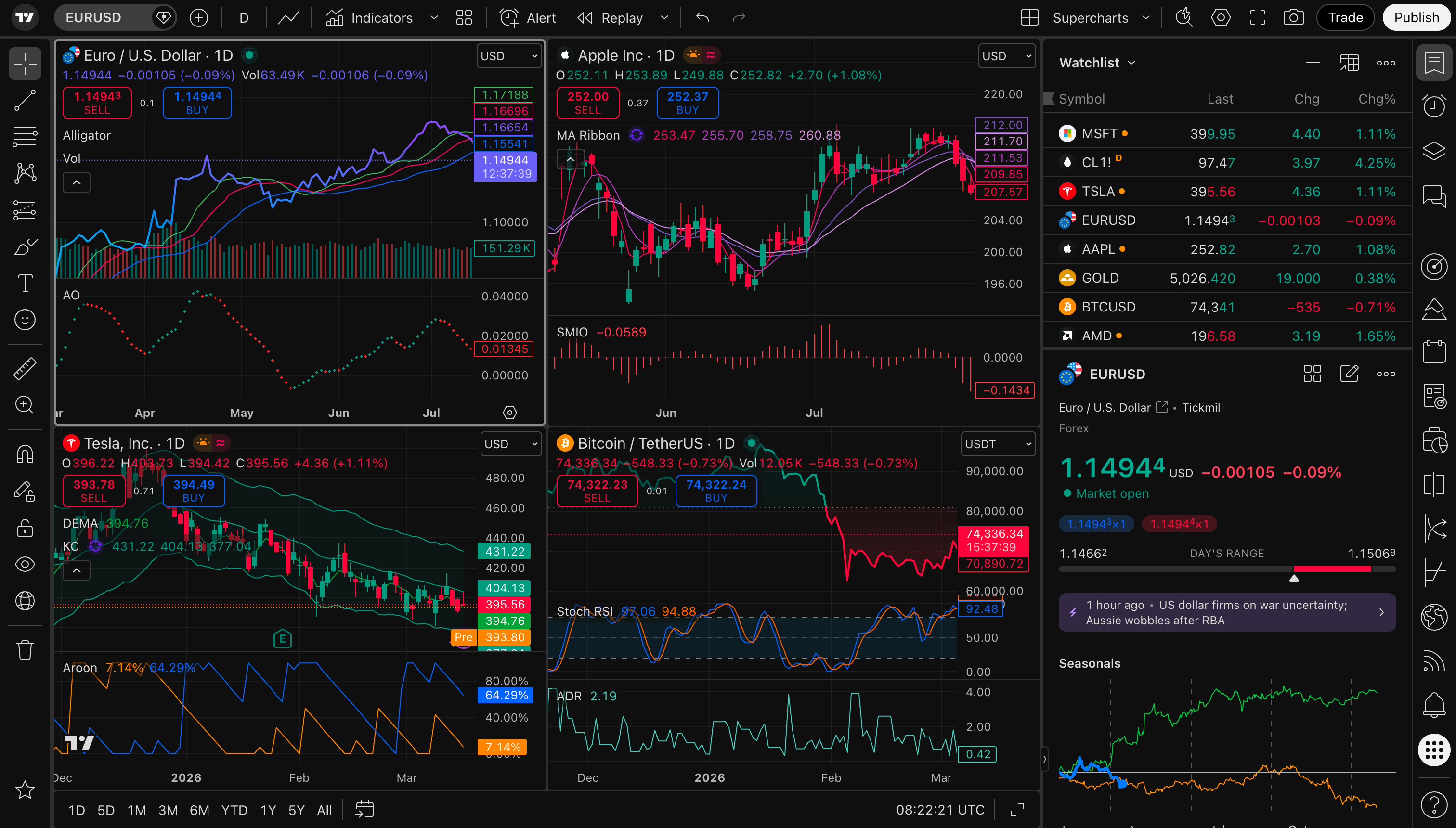

Free charts, alerts, and screeners for every asset discussed on this page. Used by 50M+ traders.
How the Alphameter Enables Regime Positioning
Alphamancy's Alphameter synthesizes six macro indicators — VIX, AUD/JPY, Copper/Gold ratio, Bond Yields, Sector Rotation, and DXY — into a single composite score that identifies the current regime as risk-on, risk-off, or neutral. Each indicator captures a different dimension of macro risk appetite: VIX measures equity fear, AUD/JPY reflects carry trade risk appetite, Copper/Gold captures industrial vs safe-haven demand, and so on. The composite approach is more robust than any single indicator because different indicators lead during different types of regime shifts. By monitoring the Alphameter daily, investors can make timely allocation adjustments without needing to interpret dozens of macro data points independently.
What the 30-Year Data Actually Shows
Episode-regime backtesting across 37 assets reveals which assets carry the regime tilt and which don't. Risk-on regimes are dominated by a handful of high-beta cyclicals and crypto: Bitcoin compounds at +62.0%/yr, Uranium (URNM) at +62.8%/yr, Brent crude at +33.2%/yr, and the Procure Space ETF (UFO) at +25.9%/yr. Risk-off regimes reward quality dividend equities and gold: SCHD +13.6%/yr, URNM +13.1%/yr (a rare two-regime winner), GLD +13.0%/yr, and NOBL +10.8%/yr. Two findings that contradict conventional wisdom: long-duration Treasuries (TLT) barely differentiate between regimes (+1.3% risk-on, +1.2% risk-off) — they are not carrying their traditional defensive weight in this dataset. And diversified equity indices like SPY show modest return separation (+11.1% vs +8.8%) but sharp drawdown separation (-30.9% MDD risk-on vs -58.5% risk-off) — the regime governs the path through the market, not just the average return.
Pitfalls and Best Practices
The biggest risk in regime-based allocation is overreacting to noise — making large portfolio shifts based on marginal or temporary regime signals. Require a sustained regime change before acting, not a single-day reading. Transaction costs and tax consequences from frequent rebalancing can erode the benefit of regime switching. Limit rebalancing to monthly or quarterly unless the signal is extreme. Avoid the temptation to layer complexity onto the regime model — two or three states are sufficient, and more granular models tend to overfit historical data. Finally, maintain humility about regime identification accuracy. No model predicts regimes perfectly, so always maintain minimum exposure to all major asset classes as insurance against being wrong.
Free charts, alerts, and screeners for every asset discussed on this page. Used by 50M+ traders.
Related Topics
Track These Indicators Live
The Alphameter synthesizes six macro indicators into a single regime score — updated daily. See the current reading and full indicator breakdown on the dashboard.
Get notified when the market regime changes
Regime alerts + weekly macro brief. Unsubscribe anytime.