Sector Rotation: Reading the Economy Through Stock Market Leadership
Learn how sector rotation between cyclical and defensive stocks signals economic expansion or contraction, and how the Alphameter uses this macro indicator.
What Is Sector Rotation?
Sector rotation is the observable pattern of capital flowing between different stock market sectors as economic conditions change. At any given time, institutional investors are making allocation decisions based on where they believe the economy is heading, and these flows create measurable shifts in relative sector performance. The core insight is that not all sectors perform equally at every point in the economic cycle. When the economy is accelerating, capital flows into sectors that benefit from rising spending and investment. When the economy is decelerating, capital rotates into sectors that provide steady earnings regardless of economic conditions. Tracking which sectors are leading and which are lagging gives you a real-time read on what the collective intelligence of the market believes about the economy's trajectory.
Cyclical vs Defensive Sectors
Cyclical sectors are those whose revenues are highly sensitive to economic conditions. Technology, consumer discretionary, industrials, financials, and materials all thrive when the economy is growing — consumers spend more on electronics and travel, businesses invest in equipment, banks earn more from lending, and manufacturers ramp up production. Defensive sectors, by contrast, produce goods and services that people need regardless of economic conditions. Utilities provide electricity, consumer staples companies sell food and household products, and healthcare companies provide medical services — demand for these is relatively inelastic. When cyclical sectors outperform defensives, it signals that investors expect continued economic growth and are willing to pay a premium for growth-sensitive earnings. When defensives lead, it signals that investors are positioning for a slowdown and prioritizing earnings stability over growth potential.
| Type | Sector | ETF | Why |
|---|---|---|---|
| Cyclical | Consumer Discretionary | XLY | Travel, retail, autos |
| Cyclical | Technology | XLK | Capex-sensitive, growth-led |
| Cyclical | Industrials | XLI | Capex, machinery, transport |
| Cyclical | Financials | XLF | Net interest margin |
| Defensive | Consumer Staples | XLP | Inelastic demand |
| Defensive | Utilities | XLU | Regulated, rate-sensitive |
| Defensive | Healthcare | XLV | Inelastic demand |
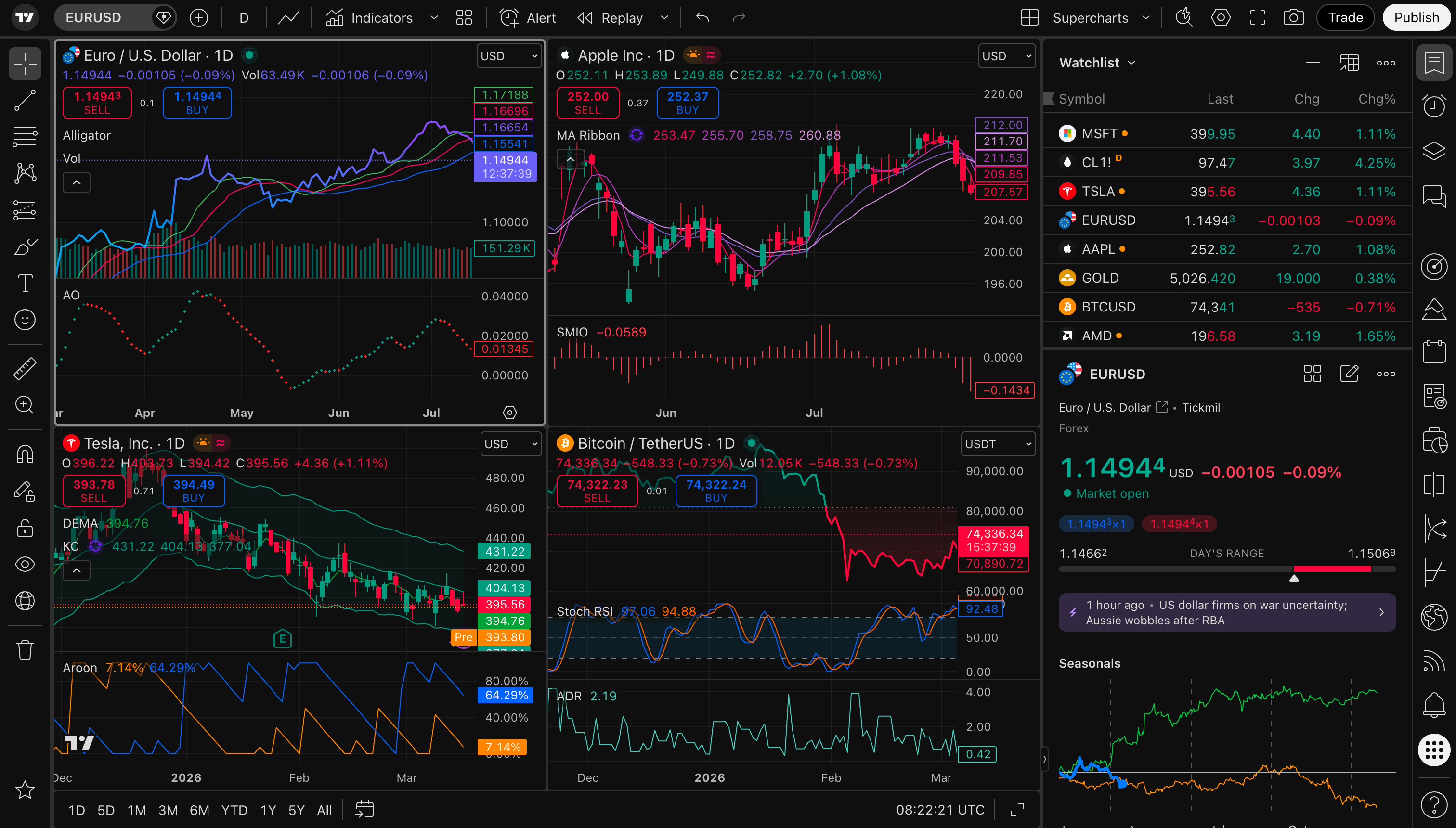

Free charts, alerts, and screeners for every asset discussed on this page. Used by 50M+ traders.
The Cyclical-to-Defensive Ratio
Alphamancy tracks sector rotation by computing a ratio of cyclical sector performance to defensive sector performance. A rising ratio means cyclicals are outperforming — a bullish signal for the broader economy and risk assets. A falling ratio means defensives are winning — a bearish signal suggesting economic deceleration. This ratio can be constructed using sector ETFs: for example, comparing the combined performance of XLK (technology), XLY (consumer discretionary), and XLI (industrials) against XLU (utilities), XLP (consumer staples), and XLV (healthcare). The ratio tends to lead the broader market because sector flows reflect institutional positioning changes that occur before headline indices fully adjust. Smart money rotates out of cyclicals and into defensives weeks or months before the S&P 500 rolls over, and vice versa.
How Alphamancy Weights Sector Rotation
In the Alphameter composite, sector rotation is used as a trend-following indicator with a 1.5x weight, tying it with the copper/gold ratio as one of the more heavily weighted components. The higher weight reflects the signal's direct connection to equity market internals — unlike commodity ratios or currency pairs, sector rotation measures where stock market investors are actually putting their money, making it particularly relevant for equity-focused portfolio decisions. The trend-following interpretation is straightforward: when the cyclical-to-defensive ratio is rising, the Alphameter adds a positive contribution to the risk-on score. When it is falling, it adds a negative contribution. This signal is especially powerful when it confirms or contradicts other indicators, such as a rising copper/gold ratio paired with rising sector rotation providing strong confirmation of an expansion regime.
Sector Rotation Across the Business Cycle
The classic business cycle framework maps specific sectors to each phase of the economic cycle. In early recovery, financials and consumer discretionary tend to lead as credit conditions ease and pent-up demand is released. During mid-cycle expansion, technology and industrials typically take the lead as capital expenditure accelerates. In late cycle, energy and materials often outperform as capacity constraints drive commodity prices higher. During recession, utilities, staples, and healthcare dominate as investors seek shelter. While this framework is useful as a mental model, real-world rotations are messier — sectors can be influenced by structural trends (like AI driving technology regardless of cycle), regulatory changes, or sector-specific events. The Alphameter focuses on the aggregate cyclical-vs-defensive ratio rather than individual sector timing, which provides a cleaner macro signal with less noise from sector-specific factors.
Free charts, alerts, and screeners for every asset discussed on this page. Used by 50M+ traders.
Related Topics
Track These Indicators Live
The Alphameter synthesizes six macro indicators into a single regime score — updated daily. See the current reading and full indicator breakdown on the dashboard.
Get notified when the market regime changes
Regime alerts + weekly macro brief. Unsubscribe anytime.