Bitcoin as a Macro Asset: Digital Gold or Risk-On Bet?
Analyze Bitcoin's evolving role as a macro asset class — digital gold narrative, correlation shifts, halving cycles, institutional adoption, and performance across regimes.
Bitcoin's Identity Crisis: Safe Haven or Risk Asset?
Bitcoin was conceived as a decentralized alternative to fiat currency, and its fixed supply cap of 21 million coins has fueled the 'digital gold' narrative. In theory, Bitcoin should behave like gold — appreciating during periods of monetary debasement, inflation, and loss of confidence in central banks. In practice, Bitcoin has spent most of its existence trading like a high-beta risk asset, rallying aggressively during liquidity-fueled bull markets and crashing harder than equities during risk-off episodes. During March 2020, Bitcoin fell roughly 50% in a single day alongside equities. During the 2022 tightening cycle, it dropped over 75% from its highs. Yet there have been fleeting episodes — particularly during banking stress in early 2023 — where Bitcoin decoupled from equities and rallied alongside gold. The asset's identity remains unsettled, which is itself a macro signal: Bitcoin's correlation profile is still being shaped by the evolution of its holder base.
The Halving Cycle and Supply Dynamics
Bitcoin's monetary policy is algorithmically fixed: approximately every four years, the block reward paid to miners is cut in half, reducing the rate of new supply issuance. The halvings in 2012, 2016, 2020, and 2024 have each preceded major bull runs, though the lag and magnitude have varied. The mechanism is straightforward — if demand remains constant or grows while new supply is cut, price rises. After the 2024 halving, Bitcoin's annual inflation rate dropped below 1%, making it scarcer than gold in terms of new supply relative to existing stock. However, the halving narrative can be overly deterministic. Each cycle has also coincided with broader liquidity expansions — the 2020 bull run aligned with unprecedented monetary stimulus, not just the halving. Sophisticated macro investors treat halvings as a supply tailwind that amplifies bullish conditions rather than a standalone catalyst.
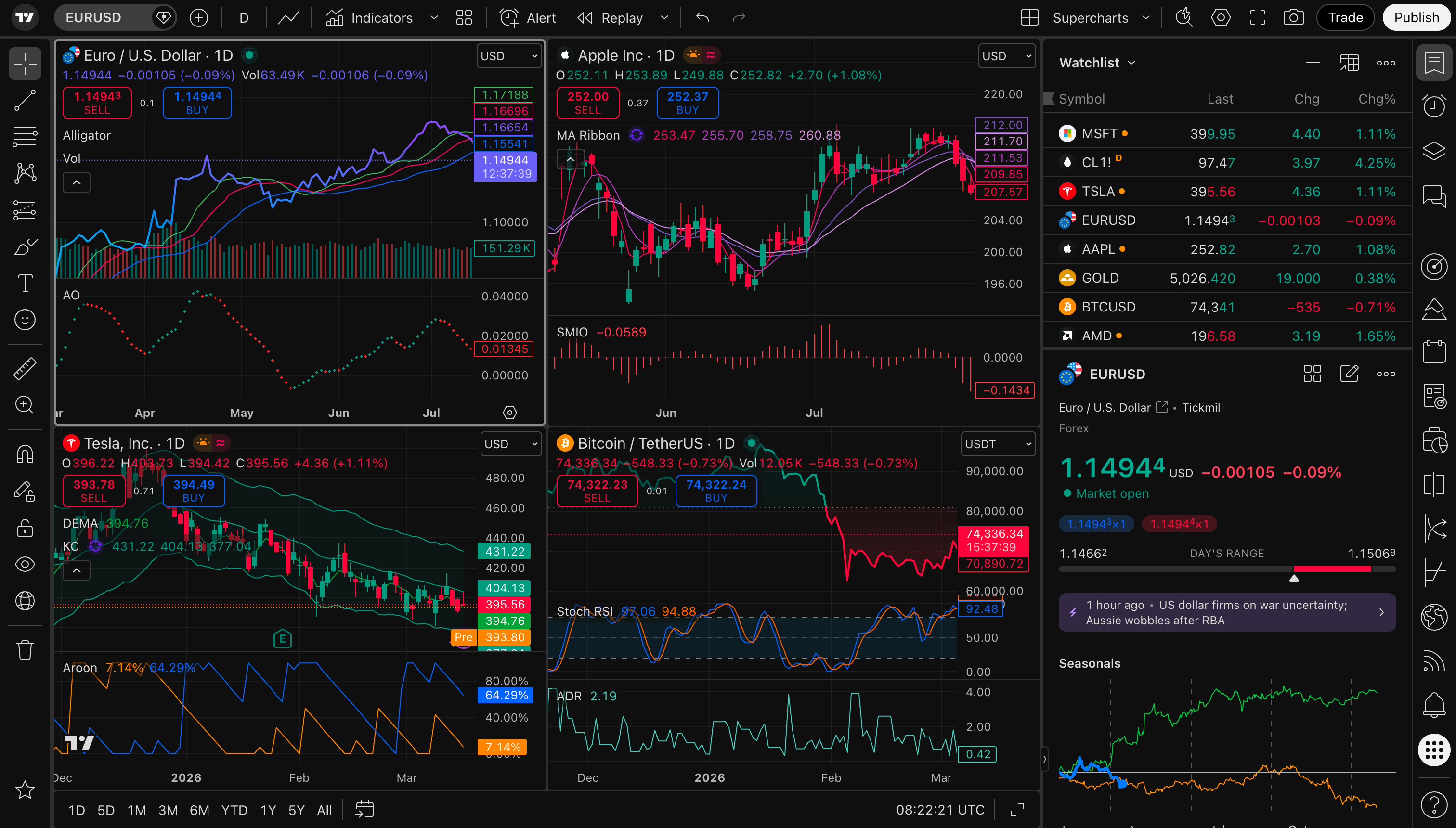

Free charts, alerts, and screeners for every asset discussed on this page. Used by 50M+ traders.
Institutional Adoption and Market Structure
The approval of spot Bitcoin ETFs in early 2024 was a watershed moment that fundamentally altered Bitcoin's market structure. Within months, billions of dollars flowed in from pension funds, registered investment advisors, and sovereign wealth funds — capital that previously had no compliant way to access Bitcoin. This institutional adoption has several macro implications. First, it deepens liquidity and may reduce volatility over time. Second, it increasingly ties Bitcoin's price to the same flows that drive traditional risk assets — when equity allocators rebalance, Bitcoin now moves with them. Third, it creates a reflexive feedback loop: as Bitcoin appears in more model portfolios, correlation with traditional assets may increase, paradoxically undermining the diversification benefit that attracted allocators in the first place. The ETF era has made Bitcoin a legitimate macro asset, but it has also made it less of an independent alternative.
Bitcoin Across Market Regimes
Bitcoin's regime sensitivity is more pronounced than almost any other asset. In risk-on environments characterized by falling real rates, expanding money supply, and strong liquidity — Bitcoin tends to outperform dramatically, often delivering multiples of equity returns. In risk-off environments driven by rate hikes, quantitative tightening, and dollar strength, Bitcoin typically underperforms equities on the downside. During stagflationary regimes, the evidence is limited but early data suggests Bitcoin does not provide the inflation protection that gold does. The most bullish macro setup for Bitcoin is a combination of accommodative monetary policy, weakening dollar, and expanding global M2 money supply. The most bearish setup is the inverse: hawkish central banks, strong dollar, and contracting liquidity. For macro-aware investors, Bitcoin is best understood as a liquidity amplifier — it magnifies whatever the prevailing macro trend happens to be.
Portfolio Sizing and Risk Considerations
Bitcoin's annualized volatility typically runs 3-5x that of the S&P 500, which means position sizing must account for the disproportionate impact it can have on portfolio-level risk. A 5% Bitcoin allocation in a traditional 60/40 portfolio can contribute 20-30% of total portfolio volatility. Many institutional frameworks suggest a 1-3% allocation as the sweet spot — enough to meaningfully boost returns during Bitcoin bull markets without catastrophically dragging the portfolio during bear markets. The key risk that distinguishes Bitcoin from traditional assets is regulatory uncertainty: governments can restrict mining, ban exchanges, or impose punitive taxation in ways that have no parallel in equity or bond markets. Additionally, Bitcoin's correlation with risk assets tends to spike during crises — precisely when diversification is most needed — which limits its hedging utility. Treat Bitcoin as a high-conviction, high-volatility macro bet on monetary debasement and digital adoption, not as a reliable portfolio diversifier.
| Allocation | Contribution to portfolio vol | Profile |
|---|---|---|
| 0% | 0% | No exposure |
| 1% | ~5–7% | Toe-dip — modest impact |
| 3% | ~13–18% | Sweet spot — meaningful upside |
| 5% | ~20–30% | Aggressive — material drawdown risk |
| 10%+ | > 40% | Concentrated bet, not diversification |
Free charts, alerts, and screeners for every asset discussed on this page. Used by 50M+ traders.
Frequently Asked Questions
Is Bitcoin a good long-term investment?▼
Bitcoin has delivered exceptional long-term returns but with extreme volatility, typically 3 to 5 times that of the S&P 500. Its performance is heavily dependent on macro conditions, thriving during periods of accommodative monetary policy and weakening dollar. Many institutional frameworks suggest a 1 to 3 percent portfolio allocation as the sweet spot for risk-adjusted exposure.
Is Bitcoin digital gold or a risk asset?▼
Bitcoin's identity remains unsettled. While its fixed 21 million supply cap supports the digital gold narrative, it has mostly traded like a high-beta risk asset, rallying during liquidity-fueled bull markets and crashing harder than equities during risk-off episodes. Brief episodes of decoupling from equities, like during the 2023 banking stress, have occurred but are not yet the norm.
What is the Bitcoin halving and how does it affect price?▼
The Bitcoin halving occurs approximately every four years when the mining block reward is cut in half, reducing new supply issuance. The halvings in 2012, 2016, 2020, and 2024 have each preceded major bull runs. After the 2024 halving, Bitcoin's annual inflation rate dropped below 1 percent, making it scarcer than gold in terms of new supply relative to existing stock.
How do Bitcoin ETFs affect the crypto market?▼
Spot Bitcoin ETFs approved in early 2024 fundamentally altered Bitcoin's market structure by allowing pension funds, registered investment advisors, and sovereign wealth funds to access Bitcoin. This deepens liquidity and may reduce volatility over time, but it also increasingly ties Bitcoin to traditional risk asset flows and rebalancing cycles.
Related Topics
Track These Indicators Live
The Alphameter synthesizes six macro indicators into a single regime score — updated daily. See the current reading and full indicator breakdown on the dashboard.
Get notified when the market regime changes
Regime alerts + weekly macro brief. Unsubscribe anytime.