Dollar-Cost Averaging: Systematic Investing for All Markets
Learn how dollar-cost averaging reduces timing risk, when DCA beats lump sum investing, and how to combine DCA with regime-aware macro frameworks.
How Dollar-Cost Averaging Works
Dollar-cost averaging is the practice of investing a fixed dollar amount at regular intervals regardless of the asset's price. When prices are low, your fixed investment buys more shares; when prices are high, it buys fewer. Over time, this mechanical approach produces a weighted-average cost basis that is lower than the simple average price over the same period. The mathematics are straightforward: by investing the same dollar amount, you are systematically buying more units when they are cheap and fewer when they are expensive, which tilts the average cost in your favor without requiring any market timing skill.
DCA vs Lump Sum: What the Research Shows
Vanguard's widely cited research found that lump-sum investing outperforms DCA roughly two-thirds of the time across historical periods, because markets trend upward over the long run and cash waiting on the sidelines earns less. However, the one-third of periods where DCA wins tend to be the most painful environments — high-volatility bear markets and prolonged drawdowns. This means DCA's advantage is not about maximizing expected return, but about minimizing the worst-case outcome. For investors who would panic-sell after a large lump-sum loss, DCA provides a behavioral safety net that keeps them invested through turbulence.
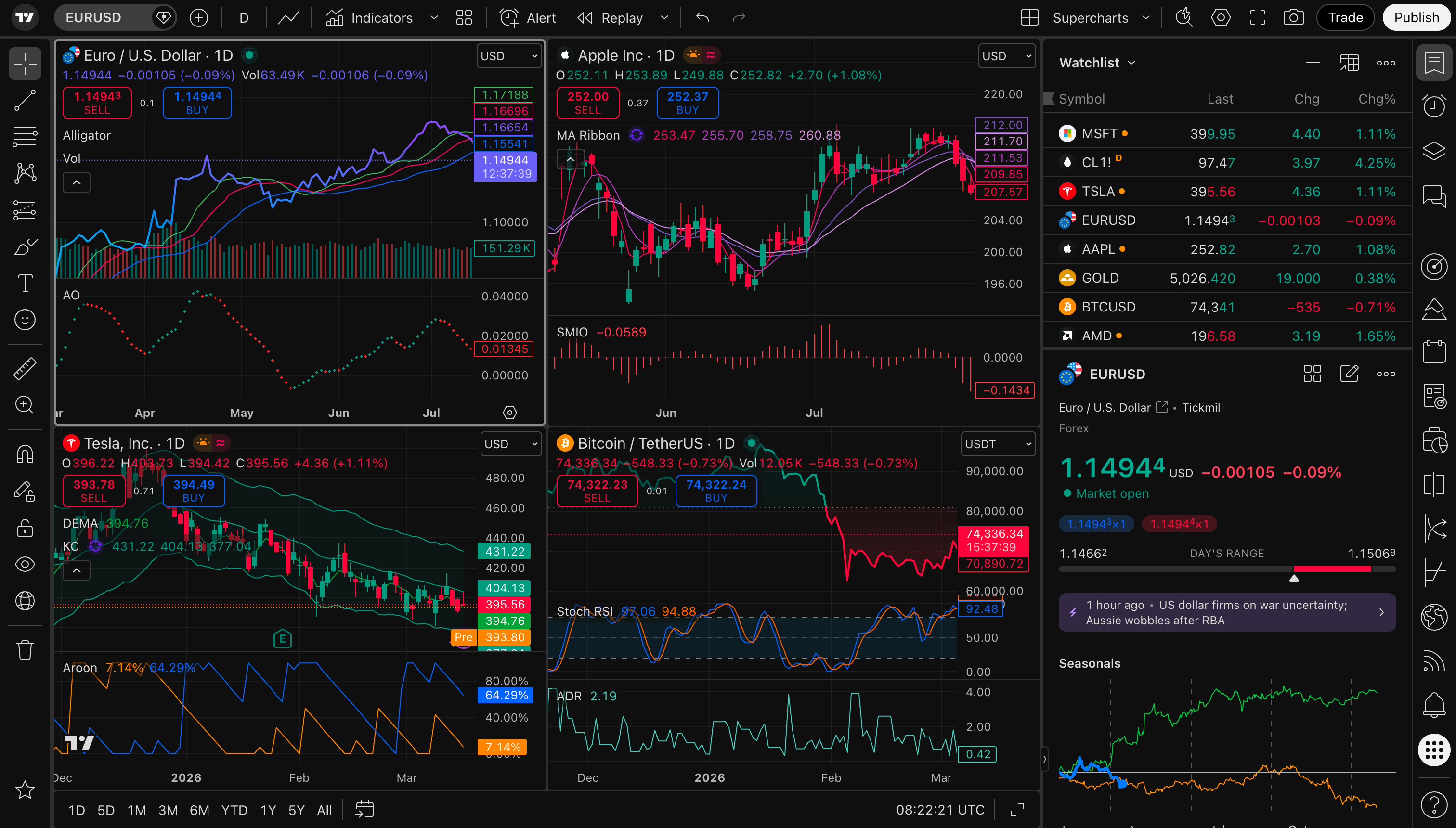

Free charts, alerts, and screeners for every asset discussed on this page. Used by 50M+ traders.
When DCA Has a Clear Edge
DCA outperforms lump sum most decisively in high-volatility, trendless, or declining markets. If you enter near a local peak — which is unknowable in advance — DCA protects you from deploying all capital at the worst possible moment. DCA also excels for volatile asset classes like crypto, commodities, and emerging market equities where drawdowns of 50% or more are routine. The higher the volatility and the flatter the long-term trend, the more DCA's cost-averaging math works in your favor relative to a single entry point.
DCA in a Regime-Aware Framework
Naive DCA ignores macro context, investing the same amount whether the market is in a strong risk-on regime or a deteriorating risk-off environment. A more sophisticated approach adjusts the DCA cadence based on regime signals: accelerate contributions during risk-off periods when assets are cheaper and fear is elevated, and slow contributions during extended risk-on rallies when valuations stretch. Alphamancy's Alphameter provides the regime context to make these adjustments. This regime-aware DCA approach preserves the discipline of systematic investing while adding a layer of macro intelligence that can meaningfully improve long-term cost basis.
Practical DCA Implementation
Choose a consistent interval — weekly or monthly — and a fixed dollar amount that you can sustain through all market conditions without interruption. The power of DCA evaporates if you stop contributing during drawdowns, which is precisely when your dollars buy the most units. Automate the process to remove emotion from the equation. Consider splitting across uncorrelated asset classes to compound the diversification benefit. Review your DCA plan quarterly, but resist the urge to time individual contributions. The entire point of the strategy is to replace discretionary timing with mechanical discipline.
Free charts, alerts, and screeners for every asset discussed on this page. Used by 50M+ traders.
Frequently Asked Questions
What is dollar-cost averaging and how does it work?▼
Dollar-cost averaging is investing a fixed dollar amount at regular intervals regardless of the asset's price. When prices are low your fixed amount buys more shares, and when prices are high it buys fewer. Over time this mechanical approach produces a weighted-average cost basis that is lower than the simple average price over the same period.
Is DCA better than lump sum investing?▼
Research shows lump-sum investing outperforms DCA roughly two-thirds of the time because markets trend upward over the long run. However, DCA wins during the most painful environments like high-volatility bear markets. DCA's advantage is not about maximizing expected return but minimizing the worst-case outcome and providing a behavioral safety net against panic selling.
How often should you dollar-cost average?▼
The most common DCA intervals are weekly or monthly. Choose a consistent interval and a fixed dollar amount you can sustain through all market conditions without interruption. The power of DCA evaporates if you stop contributing during drawdowns, which is precisely when your dollars buy the most units. Automate the process to remove emotion.
Does dollar-cost averaging work with crypto and volatile assets?▼
DCA excels for volatile asset classes like crypto, commodities, and emerging market equities where drawdowns of 50 percent or more are routine. The higher the volatility and the flatter the long-term trend, the more DCA's cost-averaging math works in your favor relative to a single entry point.
Related Topics
Track These Indicators Live
The Alphameter synthesizes six macro indicators into a single regime score — updated daily. See the current reading and full indicator breakdown on the dashboard.
Get notified when the market regime changes
Regime alerts + weekly macro brief. Unsubscribe anytime.